
Guides for building owners
ISO 19650 as Data, Not Documents: IDP vs BEP Suites
How BIMQ, Plannerly, and pragmaticBIM split by buyer job - and why an Information Delivery Plan is not a signed BEP
Published
Stop competing on "we do LOIN/IDS." BIMQ (AEC3, Germany), Plannerly (US), and pragmaticBIM (abstract ag, Switzerland) all claim pieces of that vocabulary. The useful comparison is by buyer job.
- BIMQ - authoring templates and LOIN information management for CAD teams
- Plannerly - project execution platform: Docs / Scope / Verify / Files, with BEP-class documents
- pragmaticBIM - appointing-party EIR data contracts, ordered from project goals and published as checkable artifacts
If you need native Revit/ArchiCAD attribute templates, BIMQ fits. If you need eSign BEPs and an in-app verify suite, Plannerly fits. If you need to order, version, and publish data requirements without a 300-page manual, that is pragmaticBIM’s lane.
Hard differences at a glance
| BIMQ (AEC3, DE) | Plannerly (US) | pragmaticBIM (abstract ag, CH) | |
|---|---|---|---|
| Job | LOIN information management + CAD attribute templates | Full BIM management suite (Docs / Scope / Verify / Files) | Appointing-party EIR data contracts |
| Source of truth | Cloud LOIN DB (hosted in Germany) | SaaS project DB + CDE storage | GitHub YAML per project → CI publishes S3 artifacts |
| Standout export | Native templates for ArchiCAD, Revit, ALLPLAN, ProVI + checker rules (IDS, Solibri, Zoom, …) | BEP/OIR/EIR docs, eSign, in-app model check (80+ formats), ACC sync | Web presenter + contract Excel + IDS + PDF from one use-case config |
| Standards pitch | DIN EN 17412 LOIN; DE/AT/CH master catalogues C1–C7 | ISO 19650 + LOD/LOIN matrices | LinkML open contract (MIT); IFC-backed; multi-lang DE/FR/IT/EN |
| Pricing (public) | Free → Business €110/mo → Premium €220 → Enterprise €500 | Free / Individual / Team / Enterprise (configurator; no stable public $ list) | Project 400 CHF/yr · Private Project 1'200 CHF/yr · Planner 1'800 CHF/yr per project plus 1'000 CHF onboarding · Full Enterprise 16'000 CHF/yr |
Public prices change; treat competitor figures as orientation, not a quote. pragmaticBIM’s published Project plan is 400 CHF per year and project; Private Project is 1'200 CHF per year and project; Planner is 1'800 CHF per year and project plus a one-time onboarding fee of 1'000 CHF that includes up to 3 own templates; Full Enterprise is 16'000 CHF/yr (unlimited).
ISO 19650 as data: what the IDP actually is
Plannerly and pragmaticBIM both speak ISO 19650 language. The medium of truth differs.
In pragmaticBIM’s project editor, the flow is:
Goals → Workflows → Information Delivery Plan (IDP) → publish
IDP here is not IDS. IDS is an exchange artifact you publish at the end. The IDP is the matrix that answers where and when information must appear.
| Step | Data | ISO 19650 idea (pragmatic reading) |
|---|---|---|
| Project goals + levels | Activate workflow deltas | Why / purpose (OIR-like) |
| Workflow | Use cases drive attributes | What must be delivered |
Attribute needed_for_workflows + needed_in_phases |
LOIN-like information requirement | Information need × when |
| IDP matrix | needed_for_models: model → phases |
Where (Teilmodell) × when |
| Publish | contract.xlsx + IDS + web presenter | Enforceable exchange, not a signed BEP |
Matrix cells are only checkable when a workflow-backed information requirement exists for that phase. Otherwise they stay grey. You cannot “tick the schedule” without an information requirement behind it.
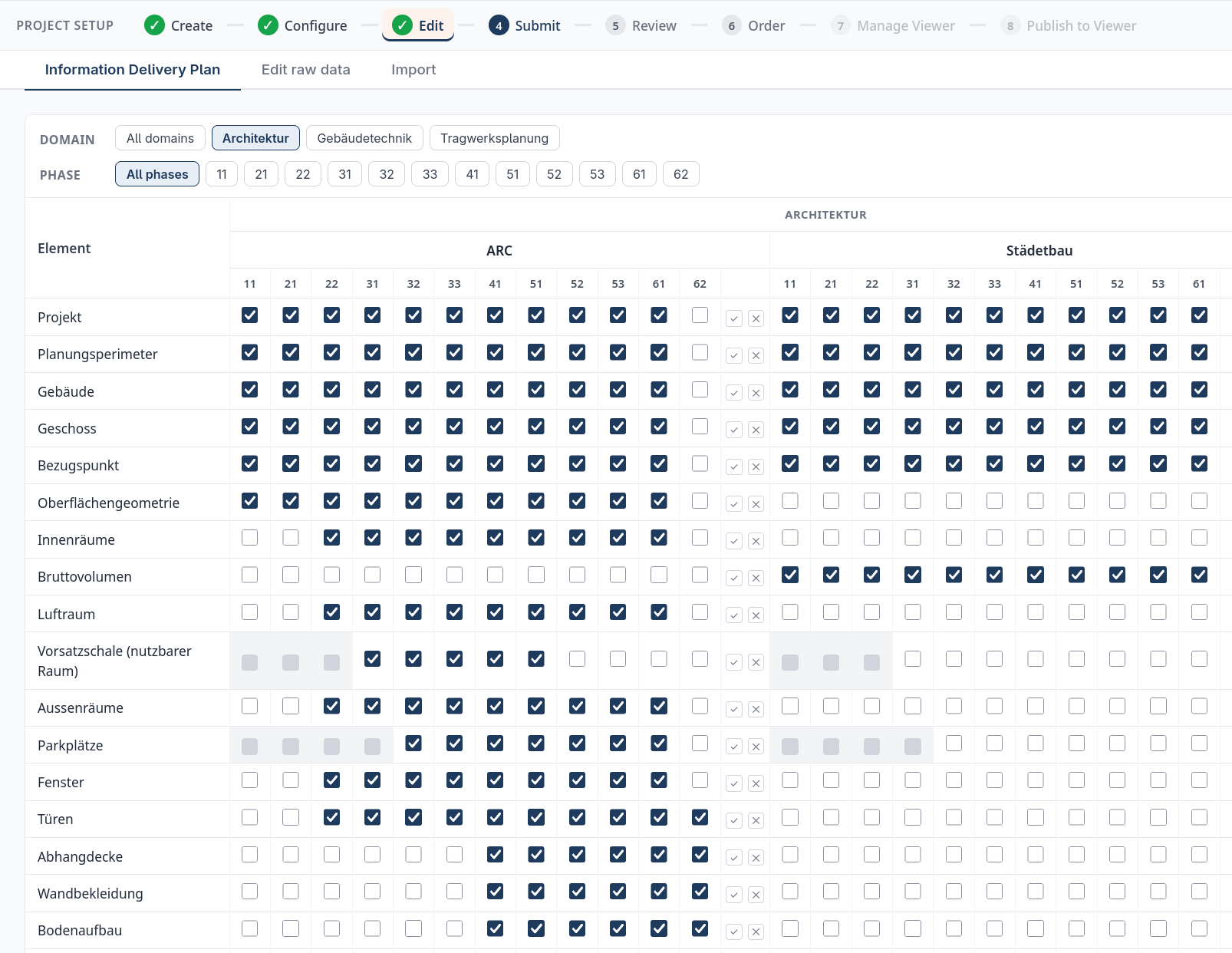
vs Plannerly: same ISO intent, different medium
| Plannerly | pragmaticBIM (IDP) | |
|---|---|---|
| Medium of truth | Docs (BEP/OIR/EIR), eSign, CDE | YAML / Git + matrix |
| "Delivery plan" | MIDP/TIDP/IPS-style document schedules | Data assignment: element → Teilmodell × phase |
| BEP | Core product module | Not a schema entity |
| Enforcement | In-app Verify + signed docs | PR → CI → IDS / Excel / presenter |
Honest limit: the schema does not name EIR, BEP, LOIN, or MIDP as product entities. That gap is the claim. pragmaticBIM is a pragmatic interpretation of ISO 19650 as data, not a document-driven BEP suite with ISO labels on every screen.
vs BIMQ: templates vs ordered contracts
BIMQ’s strength is the LOIN database plus native authoring templates and checker-rule exports for the tools planners already use. That is the right job when your bottleneck is getting attributes into ArchiCAD, Revit, ALLPLAN, or ProVI with consistent catalogues.
pragmaticBIM’s strength is upstream of authoring: the appointing party configures goals and use cases, merges them into a project contract, and publishes multi-format artifacts from Git. CAD template packs are not the product. Versioned, ordered data requirements are.
How to choose in one sentence
Buy BIMQ to standardize and push CAD attributes. Buy Plannerly to run ISO-style project documents and verification inside one suite. Buy pragmaticBIM when the appointing party must turn business goals into an Information Delivery Plan and publish enforceable data contracts - without pretending a BEP PDF is the source of truth.