




pragmaticBIM

Actionable BIM Requirements

Stop writing 300-page BIM manuals.

Configure EIR data contracts.

pragmaticBIM replaces bloated BIM Execution Plans with dynamic, version-controlled requirements your whole organization can act on.

  • Protect your investment at every handover
  • Stop rebuilding requirements for every project
  • Everyone works from the same contract
Bernhard Flühler

With Simon's support, we were able to deepen our BIM expertise in a targeted way and integrate it optimally into our office processes. Clear modelling standards and the element plan were the key to success. Model-based cost estimation worked smoothly right away and greatly strengthened BIM acceptance across the entire team.

Bernhard Flühler

Partner, Gähler Flühler Fankhauser Architekten

Giuseppe Acciardi

The element plan is a key component for us to specify data requirements. Our path was long: from an Excel sheet with version chaos and the difficulty of checking data deliveries, through collaborative work in a database and automatic IDS generation, to today's form where requirements are treated like code and have helped us keep simplifying requirements and communicating them better. The journey isn't over yet, but we're on it.

Giuseppe Acciardi

Head of BIM Program, armasuisse Immobilien

Julie Picarel

The switch from Excel to a database solution with pragmaticBIM was challenging but decisive. For the first time, we were able to capture our infrastructure data in a structured, detailed way that all project stakeholders could use. A valuable and sustainable improvement.

Julie Picarel

Senior Project Leader, Civil Engineering/BIM

Peter Maag

In GIS, we learned that what matters is not the volume of data, but its structure, quality, and usability. pragmaticBIM brings exactly this pragmatic approach to BIM. Use cases take centre stage and help you specify only what is actually needed. That prevents unnecessary complexity and creates real value for projects and operations.

Peter Maag

Head of Geomatics & Utility Coordination, Flughafen Zürich

Trusted by leading AEC innovators

Roche armasuisse Flughafen Zürich GFF Architekten Gemeinde Wettingen

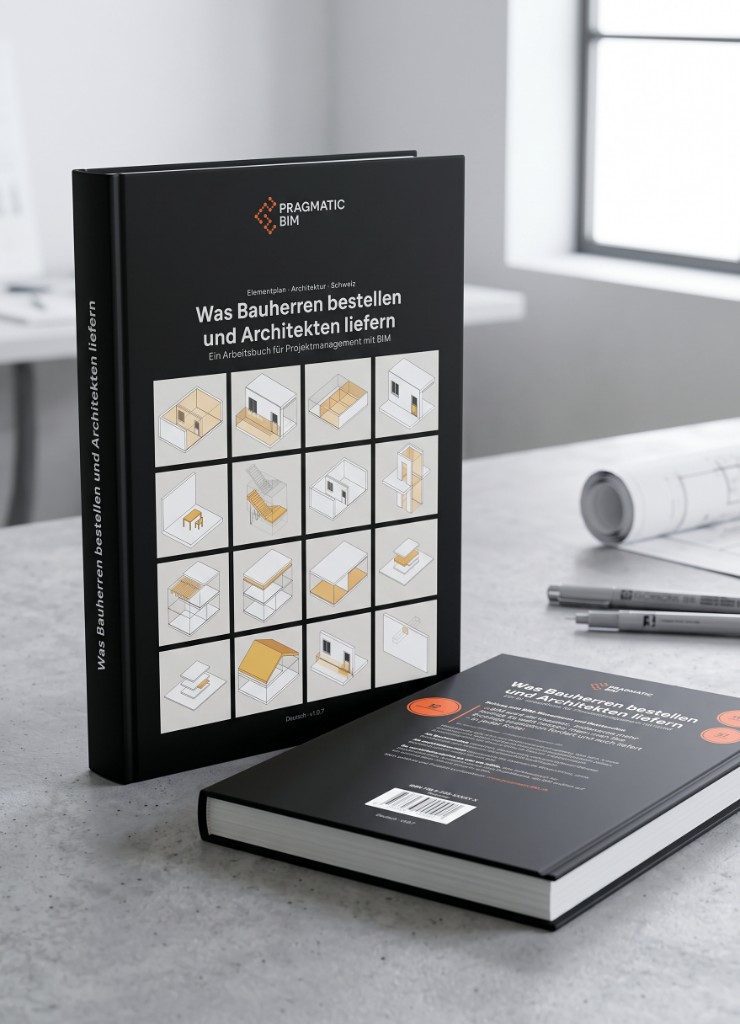
The Status Quo: Documentation Over Data

Traditional BIM Execution Plans (BAP) have become unreadable text manuals rather than checkable data requirements. They focus on manual processes instead of clean deliverables.

Template Overkill & Inflated Costs

Clients copy-paste generic, one-size-fits-all templates because specific downstream data use cases aren't defined. This drives up modeling effort and project costs.

The Non-Standardized Trap

Planners and architects receive entirely different, text-heavy specifications for every project, making it impossible to standardize or automate internal workflows.

Disconnected Data Handoffs

Requirements live in static PDFs disconnected from CAD/BIM software (Revit, ArchiCAD, Allplan). Modelers guess what parameters to input, leading to severe data loss.

How pragmaticBIM works

1

Define your data standards once

Build your organization's requirements based on real data needs - the use cases. Track changes and evolution with Git-level precision.

2

Configure the right contract for each project

Every project is different and needs different use cases. Configure the project's deliverables by selecting exactly the use cases that apply.

3

Present in every format your team needs

One source, every output. Publish as an interactive web presenter, structured Excel, machine-readable IDS, or a PDF contract addendum.

Platform Features

Merge requirements per use case

Combine templates across clients, phases, or workflows into one consistent data contract.

Extensible action plugins

Connect to your validation tools and extend workflows with custom integrations.

Connect your existing data stack

Works where your data lives - Excel, Airtable, BIMHub, or your own database.

Multi-language support

Publish specs in DE, FR, IT, and EN - automatically, from a single source.

Built-in IFC consistency checks

Validate definitions against the IFC standard before they leave your desk.

Hosted in Switzerland

Your project data stays in Switzerland - secure, GDPR-compliant, and under your control.

Pricing that scales with your projects

Published rates. Every engagement starts with a conversation.

Project

For single-scope asset delivery

400 CHF / year & project

Pay by invoice

  • Full Access to Editor
  • 1 Active Project in Presenter
  • 1 Master Template
  • Dynamic use-case merging pipeline
  • Automated IDS, Excel & PDF exports
  • Secure Swiss Cloud hosting

Enterprise

For institutional owners & large-scale developers

16'000 CHF / year

Pay by invoice

  • Unlimited project configurations & use-case merges
  • Your Own GitHub Repository
  • Dedicated Custom Domain
  • Custom action & plugin integrations
  • Global multi-language presenter access
  • Enterprise SLA & Priority Support

Professional services

Discovery Package

Workshop with leadership to identify use cases and their data requirements.

1-day workshop. Language English or German.

3'000 CHF

Implementation Service

Transition your legacy PDF manuals into structured data infrastructure. We convert your existing guidelines into clean machine-readable schemas.

FAQ

Frequently Asked Questions

Answers about EIR data contracts, ISO 19650 requirements, LinkML schemas, and actionable BIM workflows.

Frequently Asked Questions

What is an EIR data contract, and how does it replace traditional BIM manuals?

Traditional BIM manuals are often hundreds of pages of static PDF documentation - incredibly difficult to read and enforce.

An EIR (Exchange Information Requirements) data contract digitizes these rules into a machine-readable format. Define your data standards once; the platform validates project requirements automatically across the board.

How does pragmaticBIM fit abstract's contrarian approach?

Everyone tells you to follow ISO 19650 and write information requirement documents. pragmaticBIM asks what you actually need — and turns that into data contracts any model can be checked against.

That is abstract's Define step: disagree with documentation-first BIM, automate checkable requirements instead of 300-page manuals nobody reads.

How does the platform handle multi-party project collaboration?

The platform replaces dense, static documents with clear, actionable data contracts. Configure the right contract per project by selecting specific use cases, so every stakeholder knows exactly what data is required.

External collaborators can coordinate seamlessly depending on your plan:

  • Project Plan: Includes a set number of external collaborators
  • Enterprise Plan: Unlimited project access and collaboration
Can I export the data contracts into different formats for my team?

Yes. The platform presents and exports your data standards in every format your team needs.

Human-readable documentation for reference, machine-readable configurations for software tools - bridged automatically, without manual re-entry.

Does this platform integrate with standard BIM software?

Yes. Built-in IFC consistency checks and standard schema format support are included.

Automated validation ensures incoming model data matches your EIR data contracts exactly - no tedious manual data audits.

What are the pricing options available for the platform?

We offer two main pricing tiers tailored to your organization's scale.

  • Project Plan: 480 CHF / year per project - individual project management with a set number of external collaborators
  • Enterprise Plan: 16,000 CHF / year - organization-wide deployment with unlimited projects, enhanced security, custom integrations, and dedicated support
How does pragmaticBIM differ from Plannerly?

Both tools support BIM workflows, but they target different project phases.

  • Plannerly: Project execution - timelines, text-heavy BIM Execution Plans (BEPs), long-term document workflows
  • pragmaticBIM: The ordering phase - immediate machine-readable EIR contracts instead of 300-page manuals; data requirements defined up-front
How does pragmaticBIM compare to bimQ?

Different architectures for defining and managing requirements.

  • bimQ: Traditional heavy database for internal asset standardization and technical validation rules
  • pragmaticBIM: Lightweight GitHub-style versioning - data contracts like clean code, transparent change history, frictionless use-case configuration
Why use pragmaticBIM if I already use a standard IDS Editor (like Solibri)?

An IDS Editor and a data contract platform solve different problems.

  • IDS Editor (e.g. Solibri): Excellent for creating raw, machine-readable validation files - but no collaborative framework
  • pragmaticBIM: Full platform - host requirements in a web portal where clients and collaborators align on use cases and legally agree before modeling begins
How does pragmaticBIM handle requirement changes compared to static .ids files?

Instead of managing dozens of detached, un-versioned .ids or Excel files across a CDE, pragmaticBIM uses GitHub-style versioning. Every update is permanently committed as a fixed, controlled version.

The platform records who made each change, what was altered, and why - eliminating accidental edits and lost tracking.

Your team always works from a strictly managed, live single source of truth instead of trading static, unverified files back and forth.

Contact

abstract ag

Imprint · Picassoplatz 4, 4052 Basel