
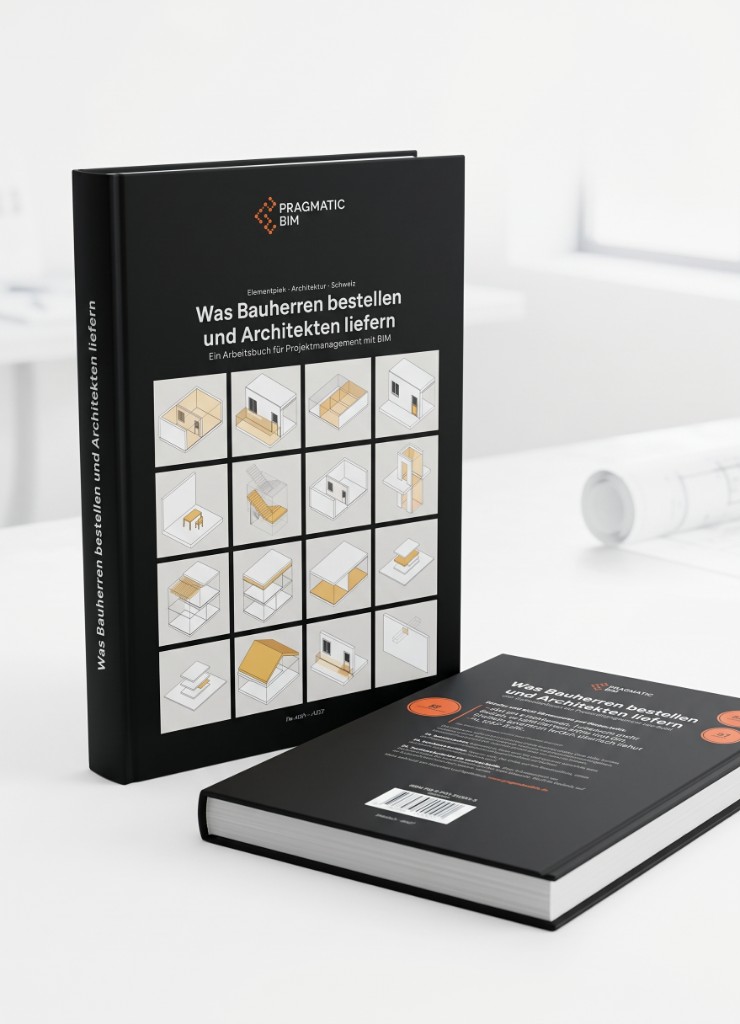
What clients order and architects deliver
The workbook for BIM project management: order results instead of prescribing methods.
Free sample
Print CHF 120
One-time licence by office size
- Team up to 25 people CHF 400
- Organization up to 250 people CHF 900
- Enterprise unlimited, one legal entity CHF 1'800

from Simon Dilhas
Architect, client representative, and lead of design-build projects. Now an entrepreneur and author. With abstract he builds the software construction projects are missing. As the BIM Pirate he pushes back on data graveyards, dictated methods, and requirements nobody can check.
Built for daily practice
-
Prevent BIM fee disputes
Clear, value-driven data requirements end multi-million discussions and replace bloated BAPs.
-
Order results, not methods
Each use case states the outcome, the process, and the attributes it needs. The method stays with the team.
-
Define how elements are modelled
The catalogue states which elements a model contains and which attributes they need for the purpose.
All connected
One continuous framework instead of isolated islands - from the strategic goal to the concrete attribute:
-
9
Goals and constraints
-
117
Use cases
-
54
Building elements
-
99
Attributes and properties
From practice
With Simon's support, we were able to deepen our BIM expertise in a targeted way and integrate it optimally into our office processes. Clear modelling standards and the element plan were the key to success. Model-based cost estimation worked smoothly right away and greatly strengthened BIM acceptance across the entire team.
Bernhard Flühler
Partner, Gähler Flühler Fankhauser Architekten

The element plan is a key component for us to specify data requirements. Our path was long: from an Excel sheet with version chaos and the difficulty of checking data deliveries, through collaborative work in a database and automatic IDS generation, to today's form where requirements are treated like code and have helped us keep simplifying requirements and communicating them better. The journey isn't over yet, but we're on it.
Giuseppe Acciardi
Head of BIM Program, armasuisse Immobilien
Trusted by leading AEC innovators



Questions
Questions
What is Elementplan?
Elementplan is the open BIM standard: a catalogue of information requirements. The book What clients order and architects deliver is the curated German edition for architecture.
The catalogue states which elements a model must contain and which attributes they need for a purpose. Requirements start from the purpose, not from the model. Each requirement traces through project goals, use cases, information containers, elements, attributes, and value lists, so it can be ordered and checked.
The Elementplan unifies the result, not the working method. The underlying data is open under the PragmaticBIM Standard License at github.com/pragmaticBIM/elementplan-swiss-starter. The book is a curated view of that data.
Who is the Elementplan architecture book for?
The Elementplan architecture book is for client representatives, architects, and project leads who order results instead of prescribing methods.
It is written for people who order, plan, model, coordinate, or check information requirements. The Elementplan is a reference for project-specific decisions, not a checklist to copy in full.
- Clients and project leads: a basis to order needed results clearly and checkably
- BIM management and coordination: a structure to turn project goals into requirements, checks, and workflows
- Planners and modellers: a desk reference for how an element is modelled and which information it needs
- Offices and project teams: a place to record decisions and reuse them
How much does the Elementplan architecture book cost?
The printed Elementplan architecture book costs CHF 120. The PDF is a one-time licence by office size: Team, up to 25 people, CHF 400; Organization, up to 250 people, CHF 900; Enterprise, unlimited, one legal entity, CHF 1'800.
The printed book is one copy. The PDF is a one-time office licence, not a subscription.
When is the Elementplan architecture book released?
Volume 1 of the Elementplan architecture book, in German, is released in Q1 2027. French- and Italian-speaking Switzerland come next, then MEP.
Why do we need Elementplan when we have IDS?
IDS is purely for checking the information. Elementplan defines which information is needed, why, and when.
A formal delivery check with IDS is only one way to work with the delivered data. The book also covers visual plausibility, further requirement checks, and calculated values. The web application on pragmaticBIM.ch can publish the same Elementplan requirements as a contract document, an IDS file, or a web view.
Do I need software to use the Elementplan book?
No. The Elementplan book stands on its own. The editor and viewer on pragmaticBIM.ch are optional when you select, adapt, agree, and publish requirements as a contract, IDS, or web view.
The web application takes no professional decisions, and the book does not replace a project agreement. Software also processes unclear orders efficiently. It does not make them clearer.
What is in the Elementplan architecture book?
The Elementplan architecture book is a German workbook in two parts: What clients order, and What architects deliver.
It explains 9 goals and constraints, 117 use cases, 54 building elements with modelling notes and IFC4 attribute tables, and 99 attributes with value ranges. The appendices document data structures, room names, and calculation logic.
It is not a standard or a norm. It is a reasoned set from practice, so later a standard and eventually a norm can be built from it.
How does Elementplan relate to ISO 19650?
Elementplan follows the idea of ISO 19650 without taking over its document structure or vocabulary. Information is derived from organisation and project goals, then made orderable and checkable as goals, use cases, containers, elements, attributes, and check rules.
It builds on buildingSMART, Bauen Digital Schweiz, SIA, and KBOB without replacing them. KBOB recommends ordering applications and digital results from the client's goals, not a method. Elementplan is the open, machine-readable reference that takes those principles down to elements, attributes, and allowed values.
It does not claim formal ISO 19650 conformity and does not replace project-specific agreements.